
The Challenge
Infrared microscopy is a powerful tool for label-free, spatially resolved chemical characterization of materials. It is widely used in environmental science, biomedical research, and materials engineering.
However, conventional infrared microscopes are often expensive, bulky, and relatively slow, partly because they rely on specialized infrared components. These limitations restrict their wider deployment in laboratories, industry, and environmental monitoring, particularly for applications requiring rapid chemical imaging over large sample areas. There is therefore a need for new approaches to infrared chemical imaging that combine high analytical performance with greater speed, simplicity, and accessibility.
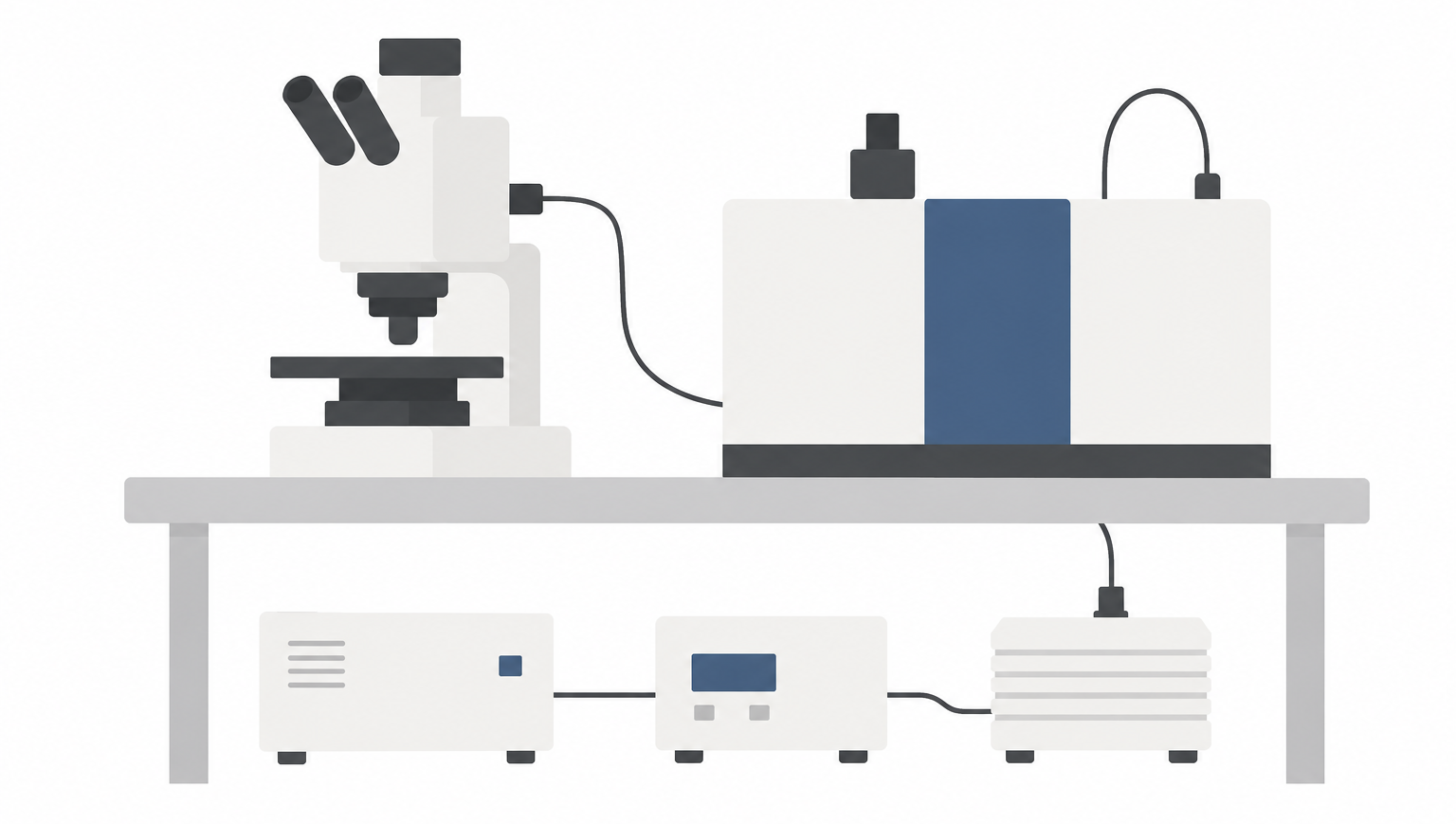
Large-footprint instrumentation conventionally used for vibrational imaging applications.
Our Vision
Q-VIBE aims to rethink infrared microscopy through quantum photonics. Rather than improving existing instruments incrementally, the project explores a new measurement paradigm that combines quantum optics with vibrational spectroscopy.
The long-term ambition is to enable a new generation of high-performance infrared chemical imaging systems that are fast, more compact, and more accessible, opening new opportunities for scientific research, industry, and environmental monitoring.
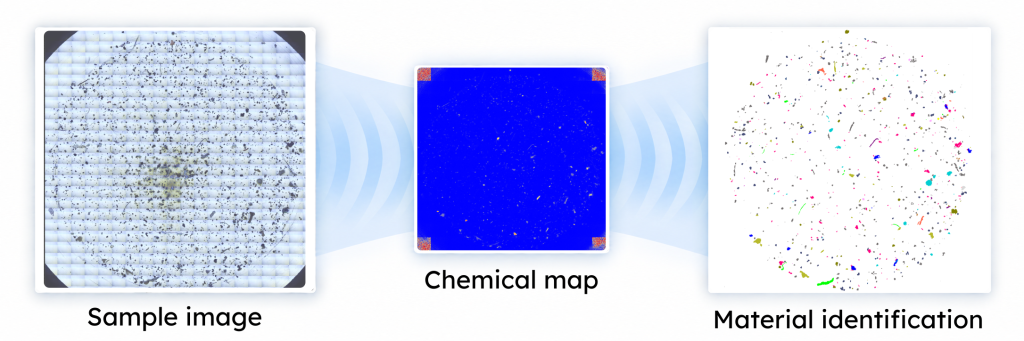
Illustrative example of spatially resolved chemical information of the type Q-VIBE aims to access.
The Technology
Q-VIBE investigates quantum-enabled imaging methods in which vibrational information can be accessed using optical detection technologies outside the conventional infrared detection range. The Q-VIBE platform combines optimized nonlinear processes for photon-pair generation with dedicated hardware for hyperspectral image acquisition.
This approach has the potential to overcome some of the current limitations of conventional infrared instrumentation while preserving the rich chemical information provided by vibrational spectroscopy. The project will explore how this concept can be translated into a practical platform for spatially resolved chemical imaging.
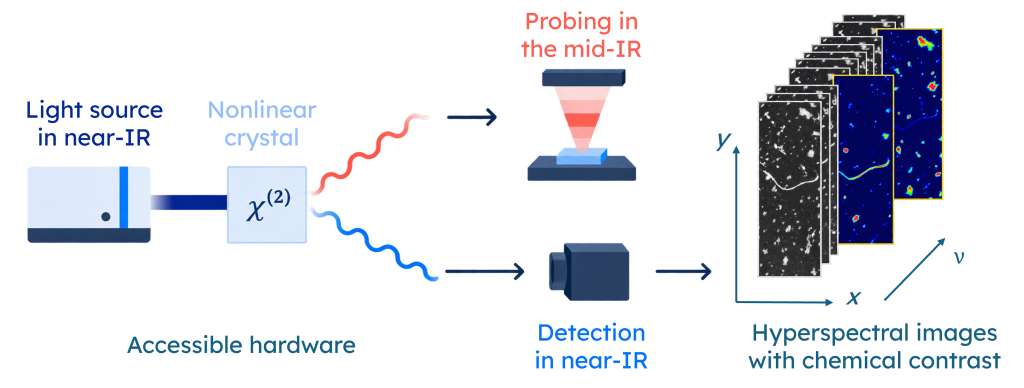
Overview of the Q-VIBE technology, from nonlinear photon-pair generation to hyperspectral image acquisition. The hyperspectral image is an illustrative reconstruction.
Applications
Microplastics analysis is Q-VIBE’s flagship real-world application and will provide a challenging testbed for the development, benchmarking, and validation of the new technology. Rapid and reliable chemical identification of microplastics is increasingly important for understanding their occurrence and distribution in environmental and biological matrices, as well as in food and other sources of human exposure. More efficient analytical tools could significantly improve environmental monitoring and exposure assessment, while supporting emerging regulatory needs.
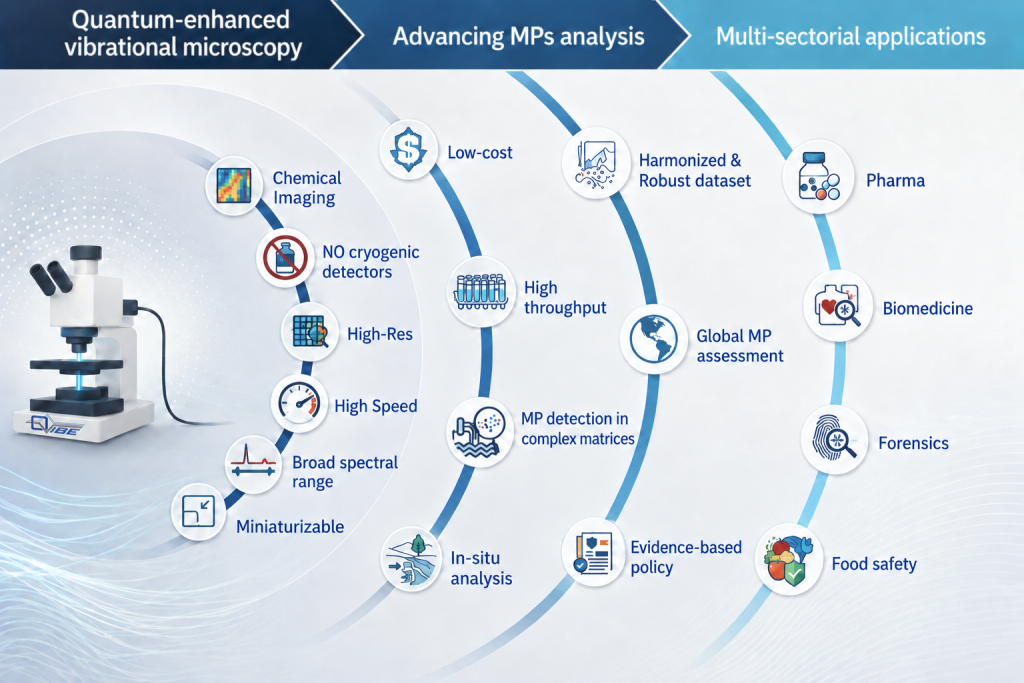
Q-VIBE’s technology opens new opportunities also across:
- environmental science
- biology
- biomedical diagnostics
- pharmaceutical analysis
- advanced materials characterization
- food quality control
- forensic analysis
- cultural heritage conservation